
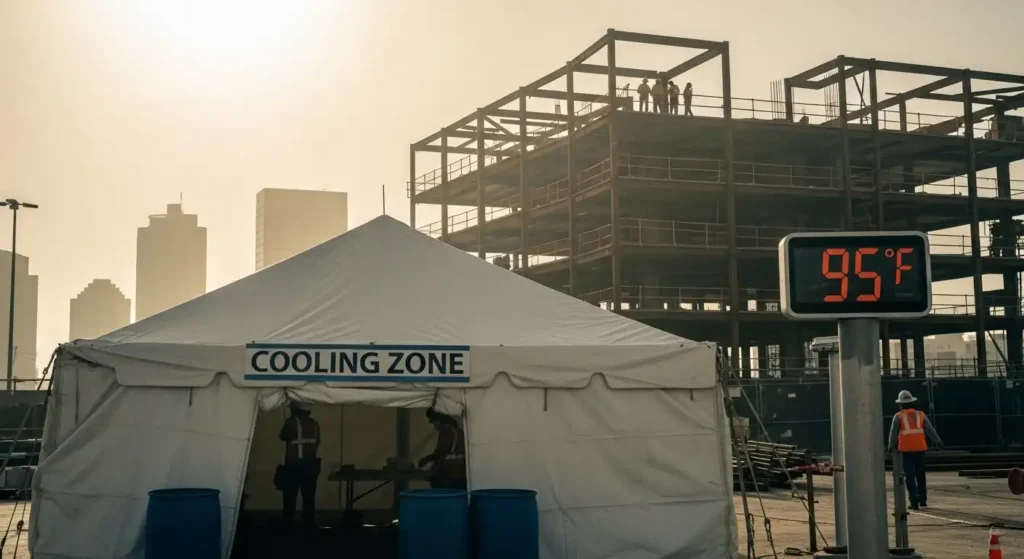
As we enter the spring and summer of 2026, California construction crews are facing a new reality on the job site. While heat has always been a hazard in the Golden State, the legal landscape surrounding it has shifted dramatically. On January 1, 2026, the expanded California Heat Illness Prevention Standards (SB 1209) went into full effect, introducing the most stringent protections for construction workers in United States history.
For decades, heat safety focused almost exclusively on outdoor agricultural and roofing work. However, the 2026 updates recognize a “hidden” danger: the hybrid environment. These are the partially enclosed shells of high-rises, unventilated warehouses under retrofit, and underground infrastructure projects where radiant heat and stagnant air create a “micro-greenhouse” effect. For workers, these conditions are lethal. For contractors, they are a source of significant new legal liability.
The 2026 Shift: Why SB 1209 Matters Now
 The core of the California 2026 heat safety laws for construction is the acknowledgment that ambient temperature is only one part of the equation. Humidity, airflow, and “transitional” spaces now dictate safety requirements. If you are working in a structure that is 70% enclosed but lacks active HVAC, you are now legally protected under the same high-heat procedures as someone working in the direct Mojave sun.
This shift is a response to a spike in “indirect” heat accidents in 2024 and 2025—incidents where a worker didn’t necessarily suffer heat stroke but fell from a ladder or mismanaged heavy machinery due to heat-induced syncope (fainting) or cognitive impairment.
Key Requirements for Contractors in 2026
Under the new mandates, every construction site in California must adhere to specific triggers based on the heat index. Failure to document these steps is often the primary evidence used in a personal injury or wrongful death lawsuit.
1. The 80-Degree Threshold: Water and Shade
When the temperature hits 80 degrees Fahrenheit, employers are now required to provide “close and comfortable” access to shade. In 2026, the definition of “shade” has been tightened: it must not only block direct sunlight but must also allow for enough space for all workers on a break to sit without touching each other, ensuring body heat doesn’t accumulate in the shade zone.
2. The 95-Degree “Extreme” Protocol
Once the heat index reaches 95 degrees, the “High-Heat Procedure” kicks in. This requires a mandatory 15-minute “preventative cool-down rest period” every hour. Crucially, contractors must now implement a “Buddy System” or regular electronic check-ins to ensure no worker is suffering in isolation, particularly those working on upper floors or in elevator shafts.
3. Mandatory Acclimatization Logs
One of the most litigated areas of the 2026 law is the “Acclimatization” requirement. Statistics show that nearly 50% of heat-related deaths occur on a worker’s first day. The new law requires contractors to maintain 14-day logs for all new hires, documenting that they were gradually introduced to high-heat tasks. If a worker is injured on day three of a job and no log exists, the contractor’s liability is nearly indefensible.
How Heat Violations Lead to Third-Party Liability Claims
While Workers’ Compensation covers medical bills and a portion of lost wages regardless of fault, a personal injury claim (a third-party lawsuit) allows for the recovery of pain, suffering, and full future wage loss. Proving a violation of the 2026 heat safety laws is the “key” to these higher-value claims.
If a general contractor or a site owner failed to provide a “Cooling Zone” (a climate-controlled area kept at 75°F or lower), and that failure led to a worker’s collapse, the victim may sue for damages beyond the limits of Workers’ Comp. This is especially true in multi-employer worksites, where a site owner may be liable for failing to provide the infrastructure necessary for subcontractors to keep their workers safe.
The Link Between Heat and Falls
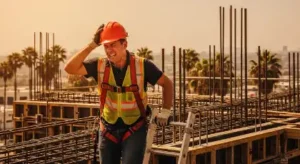 In the legal world, we often see heat as the “silent contributor” to traditional construction accidents. Consider these 2026 scenarios:
- Scaffolding Falls: A worker becomes dizzy due to dehydration and loses their balance. If the employer failed to provide water within 100 feet of the work area, the heat violation becomes the root cause of the fall.
- Equipment Accidents: Heat exhaustion causes a forklift operator to miscalculate a turn. The lack of a mandatory “cool-down” break may be the legal reason the accident occurred.
- Trenching Collapses: High heat can affect the integrity of certain shoring materials and the physical stamina of those monitoring the site’s safety.
Our firm specializes in investigating these connections. We don’t just look at the fall; we look at the temperature, the break logs, and the water access at the time of the incident.
Investigating a 2026 Heat Safety Case
When we take on a construction accident case in 2026, our investigation goes deeper than a standard police report. We secure:
- Micro-Climate Data: We use localized weather data to determine the exact heat index at the specific street corner or job site floor where the accident happened.
- HIPP Documentation: We demand the contractor’s Heat Illness Prevention Plan. If it hasn’t been updated to reflect the 2026 hybrid-environment standards, they are in violation of state law.
- Employer Communication Records: We look for “all-hands” texts or emails. Did the foreman warn the crew about the heat, or did they push for “productivity at all costs” despite a Red Flag heat warning?
Conclusion: Your Rights on a 2026 Job Site
No worker should have to risk their life for a paycheck, and “it was just a hot day” is no longer a valid legal defense for a contractor. California’s 2026 heat safety laws were written to protect you. If those protections were ignored, and you suffered the consequences, the law is on your side.
Whether you suffered from heat stroke, a fall caused by exhaustion, or a cardiovascular event triggered by high-heat labor, you deserve an advocate who understands the nuances of SB 1209 and the construction industry.