
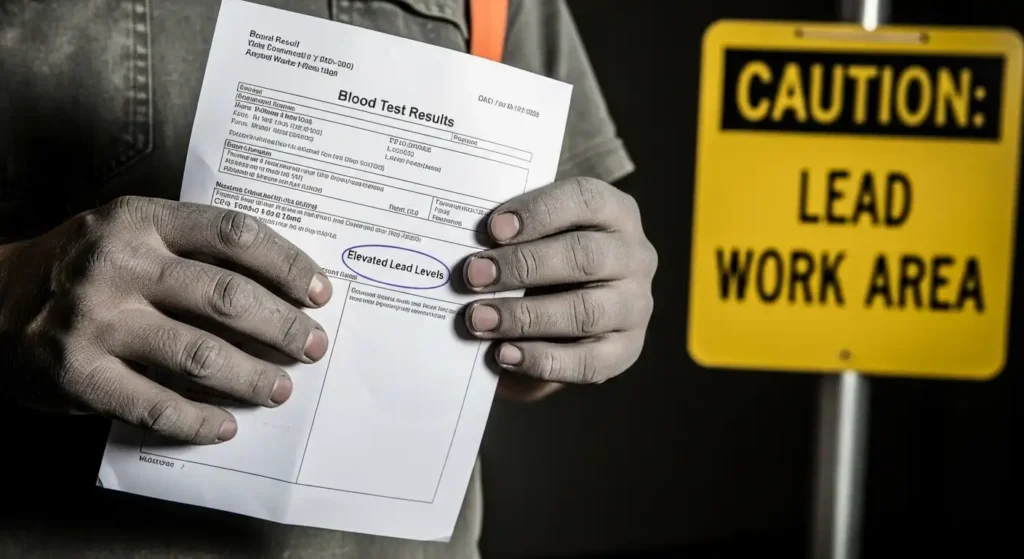
For decades, the construction industry treated lead exposure as a secondary concern, relegated to “old building” renovations and niche demolition. However, as of January 1, 2026, that complacency is no longer legal. California has officially implemented the most drastic tightening of lead safety standards in over 30 years.
The revised Cal/OSHA Lead in Construction Standard has fundamentally lowered the threshold for what is considered a “safe” amount of lead in your blood. If you have been feeling “under the weather,” experiencing chronic headaches, or struggling with high blood pressure after working on a California jobsite this year, your symptoms might not be stress or a common cold—they could be the result of a contractor’s failure to adhere to 2026 safety mandates.
The Massive Shift: New 2026 Exposure Limits
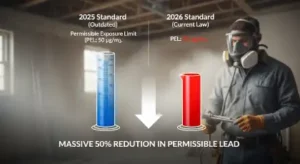 The primary change in the 2026 update involves two critical metrics: the Action Level (AL) and the Permissible Exposure Limit (PEL). These are the numbers that dictate when an employer must start testing the air and providing you with protective gear.
As of January 1, 2026, the Action Level—the point at which safety protocols must begin—has been cut significantly. More importantly, the PEL has been slashed to ensure that workers are not breathing in toxic dust that accumulates over a 40-hour work week. If your employer is still using 2025 standards, they are effectively exposing you to double the legally allowed limit of lead.
The “BLL 20” Rule: A New Standard for Medical Removal
The most significant legal protection for workers in 2026 is the updated Blood Lead Level (BLL) threshold. In previous years, a worker often had to show a dangerously high BLL before they were “medically removed” (taken off the site with pay).
Under the 2026 standard, the threshold for medical removal has been lowered to 20 μg/dl.
- Mandatory Removal: If your blood test shows a level of 20 μg/dl or greater, your employer MUST remove you from the lead-exposed area.
- Medical Removal Protection (MRP): You are entitled to maintain your full earnings, seniority, and benefits for up to 18 months while you are in a low-exposure role or recovering.
- Return to Work: You cannot be sent back into the lead area until your BLL drops below 15 μg/dl.
If your employer failed to pull you from a site despite high test results, or if they cut your pay while you were on medical removal, you may have a substantial claim for damages under 2026 labor law protections.
Is Your “Illness” Lead Poisoning? Identifying the Symptoms
Because the new 2026 limits are so much lower, many workers are experiencing “low-level” lead poisoning that was previously dismissed as general workplace fatigue. Lead is a systemic toxin that affects almost every organ in the body. Watch for these red flags:
- Neurological: Chronic headaches, “brain fog,” memory loss, and irritability.
- Cardiovascular: Unexplained high blood pressure (hypertension) or heart palpitations.
- Physical: Metallic taste in the mouth, abdominal pain, and “wrist drop” (weakness in the hands).
- Reproductive: Lead exposure in 2026 is heavily regulated due to its impact on both male and female reproductive health.
If you have these symptoms, do not rely on your company doctor alone. Consult a private physician and request a “ZPP” and “BLL” blood panel. For more on documenting these health shifts, see our guide on collecting evidence of toxic exposure.
The Employer’s 2026 Checklist: Did They Fail You?
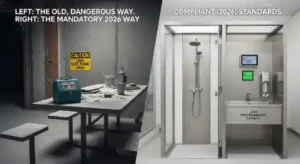 In 2026, “I didn’t know” is not a valid legal defense for a contractor. To be in compliance with the new Lead Standard, your employer must provide:
- Initial Assessment: A “competent person” must have performed an air monitoring test if lead was even suspected to be present.
- Hygiene Facilities: This is the most common violation. At the new 2026 levels, employers MUST provide clean changing rooms and end-of-shift showers to prevent “take-home lead” that can poison your family.
- Medical Surveillance: If you work in a lead area for more than 30 days a year, your employer must provide free, regular blood testing.
If you were eating lunch in a dusty area or taking your work clothes home to be washed because there were no showers on-site, your employer has violated Title 8, Section 1532.1 of the California Code of Regulations. This violation is the cornerstone of a toxic tort or personal injury claim.
Proving Negligence: The Paper Trail
In a 2026 lead poisoning lawsuit, we don’t just look at your medical records; we look at the contractor’s Compliance Plan. Under the new law, contractors must have a written compliance program that is updated annually. We subpoena these records to see if they accurately reflected the 2026 PEL and AL reductions.
We often find that subcontractors, in an effort to save money, skip the required air monitoring. By comparing your blood lead levels with the lack of air monitoring data on the site, we can build a powerful case that the employer willfully ignored safety standards to increase their profit margins.
Conclusion: Seeking Justice for Toxic Exposure
Lead poisoning is not an “occupational hazard” you have to accept—it is a preventable injury caused by corporate negligence. The 2026 California Lead Standard Update was passed specifically to protect workers from the long-term, devastating effects of heavy metal exposure.
At Construction Accident Lawyer, we understand the technicalities of the new BLL thresholds and the medical removal protection rules. If you believe your health has been compromised by lead on a California construction site, contact us today for a full evaluation of your claim. Your health and your family’s safety are worth the fight.