
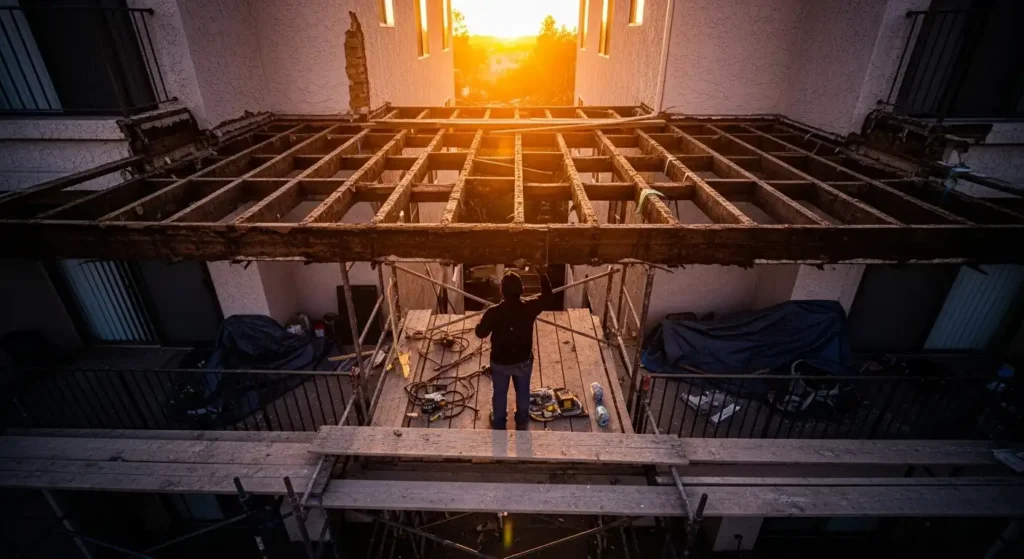
As of April 2026, California is grappling with the aftermath of one of the most significant safety mandates in the state’s architectural history. The January 1, 2026, deadline for Senate Bill 721 (SB 721)—better known as the “Balcony Inspection Law”—has passed, but its legacy is currently being written in emergency rooms and courtrooms across the state. What was designed to be a proactive safety measure has, in many cases, devolved into a “repair rush” that is causing a surge in catastrophic construction accidents.
Property owners who waited until the eleventh hour to inspect and repair their “Exterior Elevated Elements” (EEE) are now facing a reality of structural decay, unqualified labor, and compromised safety protocols. At constructionaccidentlawyer.org, we are seeing a direct correlation between the pressure to meet the 2026 deadline and a rise in preventable falls and structural collapses.
The Perfect Storm: Why 2026 is the Year of the Balcony Accident
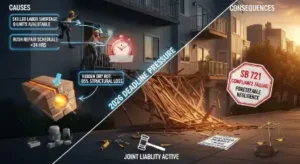 SB 721 requires buildings with three or more multi-family units to have their balconies, decks, and walkways inspected for structural integrity. However, the sheer volume of buildings requiring repair exceeded the capacity of California’s skilled labor force. This has created a “perfect storm” for accidents:
- The Scarcity of Skilled Contractors: With thousands of buildings needing immediate work to avoid daily fines, many property owners have turned to unlicensed or general-purpose contractors who lack the specialized knowledge required for structural wood-rot remediation.
- The Speed Trap: Pressure to complete repairs before local jurisdictions issue “Stop Use” orders has led to shortcuts in scaffolding assembly and the bypassing of mandatory fall protection systems.
- Hidden Structural Decay: As workers begin to strip away stucco and waterproofing, they are often discovering decay far more extensive than initial inspections suggested. Without proper shoring, these weakened structures are collapsing mid-repair.
Liability in the Post-Deadline Era: Who is Responsible?
If you are a worker injured on a balcony repair site, or a tenant injured by a “rushed” repair, the legal landscape of 2026 offers several avenues for recovery. Liability in these cases is rarely limited to a single party.
1. Property Owner Negligence
Under 2026 legal standards, a property owner who fails to provide a safe work environment can be held liable for injuries. If an owner knowingly hired a “low-bid” contractor without verifying their safety record or license status in an effort to save money during the SB 721 rush, they may be guilty of negligent hiring. This is a critical factor in complex structural litigation.
2. The “Deep Pocket” Joint Liability
Much like the Joint Liability shifts we have seen in wage theft cases, general contractors are now being held strictly accountable for the safety violations of their subcontractors. If a sub-contractor fails to provide proper fall-arrest gear to a worker on a balcony project, the General Contractor (GC) may be legally responsible for the resulting damages.
3. Professional Malpractice by Inspectors
In some cases, the accident occurs because the initial SB 721 inspection was performed poorly. If an inspector gave a “passing grade” to a balcony that later collapsed during minor repairs, that inspector and their firm can be sued for professional negligence. We use Digital Twin Modeling to reconstruct the state of the wood at the time of the inspection to prove these claims.
The 2026 Fall Protection Mandates
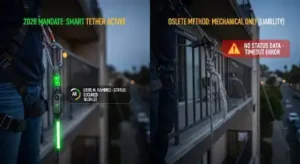 The 2026 Cal/OSHA updates have specifically targeted “Leading Edge” work, which includes most balcony repairs. Standard guardrails are often removed during these projects, meaning workers must be tethered. If you were injured because your employer failed to provide a 2026-compliant “Smart Tether” system—which alerts supervisors when a worker is unclipped—you likely have a high-value personal injury claim.
This mirrors the technological accountability we see in other industries, such as the 10-minute response rule for autonomous vehicles. Technology exists to prevent these accidents; failing to use it is a choice that carries legal consequences.
Legal Alert: In 2026, insurance companies are increasingly denying claims for “unauthorized repairs.” If a property owner attempted to fix a balcony without a permit to save time, their insurance may refuse to pay, leaving the owner personally liable for your medical bills and lost wages.
How We Prove Your Balcony Repair Claim
Proving a “repair rush” accident requires a different approach than a standard construction claim. At constructionaccidentlawyer.org, our 2026 investigative toolkit includes:
- Drone Photogrammetry: We use drones to create 3D maps of the site, identifying where scaffolding was improperly braced against a decaying wall.
- Permit vs. Reality Audits: We compare the scope of work filed with the city against what was actually happening on the day of the accident. Often, “cosmetic” permits are used to hide “structural” work.
- Telemetry and Wearable Data: Much like the data used in San Francisco e-moto accident forensics, we can often pull data from worker wearables to prove that they were working in high-wind conditions or without proper rest breaks.
Conclusion: Justice for the Victims of the Rush
The SB 721 deadline was supposed to make California safer. Instead, the “Balcony Repair Rush” of 2026 has created a new class of victims. Whether you are a laborer who fell from a third-story walkway or a tenant injured by falling debris, the law provides a pathway for you to recover your losses and hold negligent parties accountable.
As the “deep carbon cycle” of our infrastructure—the aging wood and steel of our cities—continues to fail, the need for rigorous legal oversight has never been greater. We are here to ensure that “rushing to meet a deadline” is never accepted as an excuse for human tragedy.
Injured during an SB 721 balcony repair or inspection? Don’t let the property owner’s negligence become your financial burden. Contact constructionaccidentlawyer.org today for a free, confidential consultation. We lead the way in 2026 California structural litigation.