
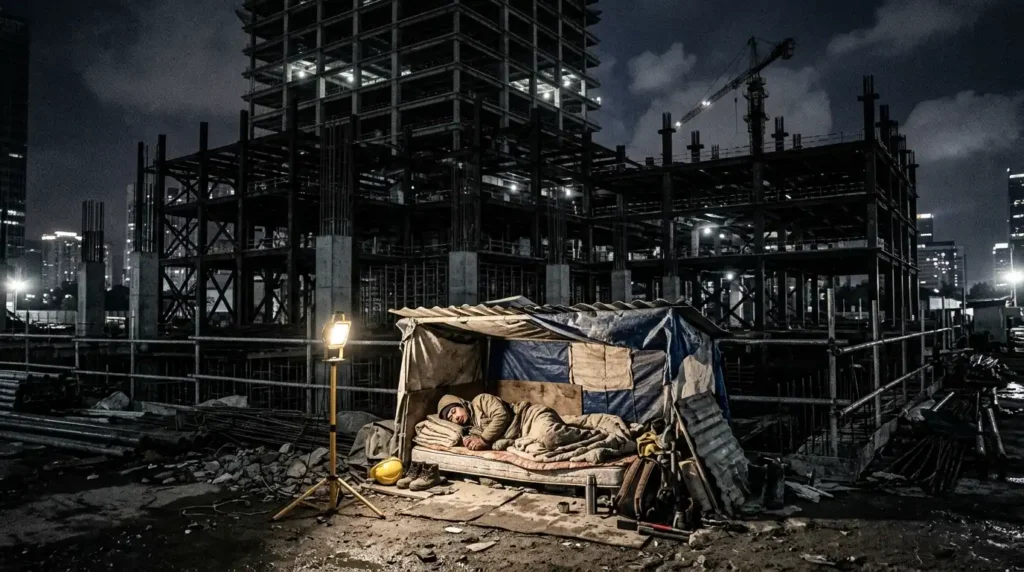
In the high-pressure world of modern construction, the drive to meet project deadlines often leads to corners being cut. However, one practice has emerged in 2026 as a significant legal flashpoint: the “sleeping-on-site” policy. Whether born of logistical necessity in high-density urban areas or simply an attempt to maximize productivity, allowing or requiring workers to sleep within active construction zones is creating a new wave of complex litigation. When a structural failure or accident occurs, these cases often move well beyond the boundaries of standard workers’ compensation, exposing contractors to severe liability under premises liability and gross negligence statutes.
The “Hidden” Hazard: Why Contractors Permit On-Site Sleeping
 To understand the legal stakes, one must first understand the reality of the site. In mixed-use projects—where a building is intended to house both residential and commercial spaces—the lines between “work zone” and “living space” become dangerously blurred. Contractors may encourage crews to stay on-site to reduce travel time, secure valuable equipment, or push for 24-hour construction schedules.
However, an unfinished building is not a home. It lacks basic fire safety protocols, proper ventilation, secured flooring, and emergency egress routes required by residential building codes. When a structure is in flux—with heavy machinery operating, electrical wiring exposed, and structural load-bearing elements being added—it is inherently unstable. Turning this environment into a living quarter is a fundamental violation of site safety standards.
The Legal Shift: Beyond Workers’ Compensation
In most construction accident cases, the exclusive remedy provision of workers’ compensation insurance prevents employees from suing their employer directly. They receive medical coverage and lost wages, but they cannot seek damages for pain and suffering. Construction site liability for worker housing, however, breaks this mold.
When an employer provides housing—especially in an inherently dangerous area like an active construction site—the legal relationship changes. Courts are increasingly viewing this arrangement as an extension of the employer’s premises liability. If a worker is injured during a structural collapse or electrical fire while sleeping on-site, the attorney can argue that the injury occurred due to the employer’s failure to provide a safe living environment, rather than a standard job-related accident. This opens the door to third-party claims and significant settlements that far exceed what a standard workers’ compensation claim would provide.
The “Duty of Care” Argument
The core of these legal battles rests on the “duty of care” owed by general contractors to the men and women on their site. In 2026, the threshold for what constitutes “reasonable care” has been raised by recent case law. If a general contractor knows, or should have known, that their workers are sleeping in an unfinished high-rise, they have an affirmative obligation to ensure the sleeping area is isolated from construction hazards.
We are seeing success in litigation by proving that the contractor prioritized speed over the basic human right to a safe environment. Key elements that support these claims include:
- Evidence of Employer Knowledge: Proof that supervisors knew or encouraged the sleeping arrangements.
- Structural Instability: Documentation showing that the area designated for sleeping was located near areas undergoing structural welding or heavy excavation.
- Lack of Fire Safety: The absence of smoke alarms, sprinklers, or designated fire exits in the makeshift living quarters.
- Economic Coercion: Evidence that workers felt forced to stay on-site to maintain their jobs, neutralizing the argument that their presence was “voluntary.”
Navigating Mixed-Use Hazard Claims
 Mixed-use construction projects present a unique danger. Because these buildings are designed to be safe for future residents, contractors often treat them with a sense of “pre-completion safety” that is entirely unfounded. They may fail to fence off hazardous elevator shafts or secure open floor edges because they believe the building is “mostly finished.”
For a victim of a construction site accident, documentation is paramount. If you or a loved one were injured while staying on a site, document everything. Take photos of the sleeping area, record any communications with supervisors regarding your housing, and retain any evidence of unsafe conditions in your immediate vicinity. This evidence is the foundation of proving that the construction site had become a dangerous living space under the control of a negligent contractor.
Conclusion: Prioritizing People Over Projects
The industry’s push toward efficiency should never come at the expense of human safety. The emerging trend of holding contractors accountable for “living-on-site” policies is a necessary correction to a dangerous industry practice. If you are a construction worker in 2026, you deserve a safe place to work and a safe place to rest.
If you find yourself in a situation where your employer is prioritizing project timelines by housing you on an active site, be aware of the risks. Should an accident occur, you need to understand that your rights may extend beyond the limits of workers’ compensation. Our firm specializes in uncovering the root causes of construction site negligence. Contact us today for a free consultation to discuss your situation and ensure your rights are fully protected under the law.