

The Two-Track Legal System Explained
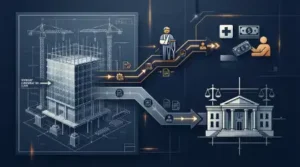
Following a workplace injury, two distinct legal systems can be triggered simultaneously from the exact same incident, each governed by different rules, standards of proof, and financial caps:
- Track 1: The Workers’ Compensation Claim (No-Fault Administrative System): Workers’ compensation is an insurance system designed to provide prompt medical treatment and partial wage replacement without requiring you to prove that anyone did anything wrong. In exchange for these guaranteed no-fault benefits, state laws establish the “exclusive remedy” doctrine, which generally prohibits you from suing your direct employer or a co-worker for ordinary negligence.
- Track 2: The Third-Party Personal Injury Lawsuit (Fault-Based Civil Litigation): While your direct employer is shielded from a negligence lawsuit, that legal immunity does not extend to outside entities. If a general contractor, independent subcontractor, property owner, architect, or equipment manufacturer created or failed to correct a dangerous condition, you can file a civil personal injury lawsuit against that negligent third party.
Who Qualifies as a Liable “Third Party” on a Construction Site?
Unlike a traditional office or retail workplace, a commercial or residential construction project involves dozens of overlapping contracts. Identifying third-party liability requires investigating every entity with control over job-site safety, equipment, or site conditions. Common third-party defendants include:
- General Contractors and Construction Managers: Entities that retain overall control over site safety protocols, scheduling, and multi-trade coordination but fail to enforce fall protection or hazard abatement standards.
- Independent Subcontractors: Another trade crew—such as scaffolding erectors, electrical contractors, or crane operators—whose unsafe work creates hazards for workers employed by different companies.
- Equipment and Tool Manufacturers: Companies that design, manufacture, or distribute defective power tools, nail guns, ladders, harnesses, or heavy machinery under product liability law.
- Property Owners and Developers: Landowners who fail to warn contractors of hidden structural defects, underground utility lines, or toxic environmental hazards on the premises.
- Outside Delivery Drivers and Vendors: Negligent motorists or material suppliers operating delivery trucks or forklifts in active work zones.
Regulatory safety findings frequently uncover these overlapping duties. When agencies like the Occupational Safety and Health Administration investigate a severe construction incident, their citations often reveal multi-employer violations—identifying both the creating contractor and the controlling contractor responsible for the hazard.
Comparing Damages: Why Dual Claims Matter Financially
Pursuing both claims simultaneously is critical because workers’ compensation alone leaves substantial financial gaps. By statute, workers’ comp benefits are capped and exclude non-economic losses. A third-party civil lawsuit bridges those gaps by allowing you to pursue full, uncapped damages:
| Category of Recovery | Workers’ Compensation Claim | Third-Party Personal Injury Lawsuit |
|---|---|---|
| Proof Required | No fault required (must occur in course of employment) | Must prove third-party negligence or product defect |
| Medical Expenses | Covered through approved medical network | Full past and future medical care, including specialists |
| Lost Wages | Partial replacement (typically ~60% to 66.7%, subject to state caps) | 100% of lost wages plus diminished future earning capacity |
| Pain and Suffering | Not available | Fully recoverable (physical pain, trauma, loss of enjoyment) |
| Timeline of Payout | Immediate ongoing medical and biweekly disability checks | Lump-sum settlement or verdict upon litigation resolution |
As outlined by the U.S. Department of Labor, workers’ compensation serves as an immediate safety net while you are unable to work, whereas a third-party tort claim holds negligent outside parties accountable for the true human and economic cost of a catastrophic injury.
How Subrogation and Workers’ Comp Liens Interact
Because both claims arise out of the same physical injury, the law prevents a plaintiff from collecting a “double recovery” for the exact same dollar of medical care or lost wages. This coordination is handled through a legal mechanism known as subrogation.
When your employer’s workers’ compensation carrier pays for your surgeries, physical therapy, and temporary disability checks during your recovery, that insurer acquires a statutory workers’ compensation lien against any future settlement or verdict you win in your third-party lawsuit. When your third-party case resolves, the workers’ comp carrier is entitled to be reimbursed from the civil proceeds for the benefits it already paid.
However, a workers’ comp lien does not mean the insurance company takes your entire settlement—nor is the lien amount set in stone. Experienced construction accident attorneys routinely reduce or offset these liens through several legal strategies:
- Pro-Rata Attorney Fee and Cost Reductions: Under state equitable apportionment rules, the workers’ comp insurer must typically reduce its lien proportionally to share in the legal fees and litigation costs you incurred to win the third-party recovery.
- Employer Comparative Fault Offsets: In many jurisdictions—under doctrines such as California’s Witt v. Jackson rule—if your direct employer’s own negligence contributed to the unsafe site condition, the workers’ comp carrier’s reimbursement right is reduced or eliminated in proportion to the employer’s percentage of fault.
- Negotiated Lien Compromises: Attorneys frequently negotiate directly with the workers’ comp carrier before finalizing a third-party settlement, persuading the insurer to accept a discounted lump sum or waive future credit rights so the settlement can close cleanly.
Step-by-Step Procedural Coordination
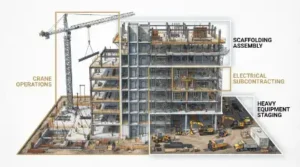
Managing dual claims requires careful timing so that actions taken in one forum do not accidentally undermine the other. Following a construction accident, the coordinated legal process generally follows four critical phases:
- Immediate Injury Reporting and Medical Documentation: Report the injury to your supervisor within statutory deadlines to preserve workers’ comp eligibility, while ensuring your medical records accurately document the exact mechanism of the accident.
- Independent Site Investigation and Preservation: Before job-site conditions change, legal counsel issues formal evidence preservation notices to general contractors and equipment owners, securing safety logs, contracts, and defective machinery.
- Parallel Filings and Discovery: Your workers’ comp claim provides ongoing medical treatment and wage benefits while your civil legal team files the third-party complaint, conducts depositions, and retains engineering experts.
- Global Settlement and Lien Resolution: Prior to signing any third-party release—a step that generally requires formal consent from the workers’ comp carrier under state statutes to avoid forfeiting future benefits—your attorney finalizes the lien reduction and distributes your net civil recovery.
Because deadlines, notice rules, and subrogation statutes vary significantly by jurisdiction—for example, California’s Labor Code sections 3850–3865 govern third-party subrogation, as detailed through the California Division of Workers’ Compensation—working with legal counsel experienced in both systems ensures that every dollar of recovery is protected. Guidance from the American Bar Association similarly emphasizes coordinated representation when workplace injuries involve outside tortfeasors, allowing injured workers to focus on physical rehabilitation while their legal team maximizes both claims.