
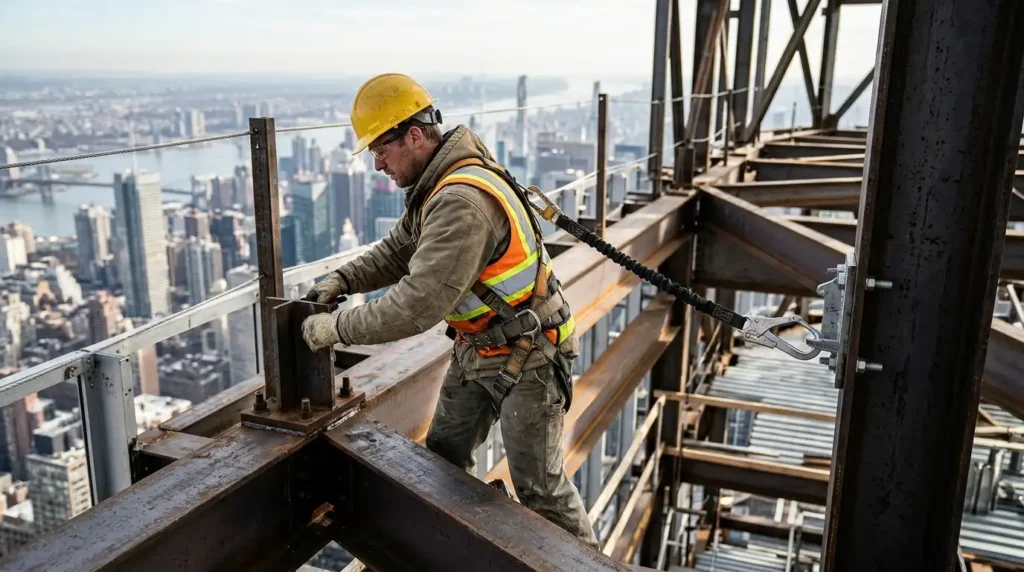
Construction sites are among the most dynamic and hazardous work environments in the United States. Every day, thousands of tradespeople—from ironworkers and roofers to carpenters and electricians—operate at elevated heights to build the commercial and residential infrastructure of our cities. However, working high above the ground comes with severe inherent risks.
According to the Occupational Safety and Health Administration (OSHA), falls represent the single leading cause of worker fatalities in the construction industry. Falls belong to what OSHA classifies as the “Fatal Four” hazards—which also include struck-by incidents, caught-in/between hazards, and electrocutions. Understanding strict construction safety standards is essential not only for preventing catastrophic injuries on the job site, but also for establishing legal liability when a failure in site management results in a life-altering accident.
Understanding OSHA’s General Fall Protection Standard (29 CFR 1926.501)
OSHA’s fall protection regulations for construction are explicit. Under 29 CFR 1926.501, employers must provide adequate fall protection for employees working on any walking or working surface with an unprotected side or edge that is 6 feet or more above a lower level.
Despite being a foundational rule of job site safety, fall protection violations consistently rank as OSHA’s most frequently cited standard year after year. To comply with federal safety mandates, general contractors and site managers must implement one or more of the following primary protection systems whenever elevated work is performed:
1. Guardrail Systems
Guardrails serve as the primary physical barrier against fall hazards. A compliant guardrail system must feature top rails positioned 42 inches (plus or minus 3 inches) above the walking surface, capable of withstanding at least 200 pounds of outward or downward force. Midrails must be installed halfway between the top rail and the working platform, and toeboards must be installed to prevent tools and materials from falling onto workers below.
2. Personal Fall Arrest Systems (PFAS)
When guardrails or safety nets are impractical, contractors must equip workers with an engineered Personal Fall Arrest System. A complete PFAS consists of three vital components: a secure anchorage point, a full-body harness, and a shock-absorbing lanyard or self-retracting lifeline (SRL). OSHA explicitly mandates that anchorage points used for PFAS must be independent of any platform support and capable of supporting at least 5,000 pounds per attached worker.
3. Safety Net Systems
Safety nets are deployed beneath elevated work surfaces, such as bridges or high-rise steel frames, where conventional scaffolding or harness systems are limited. Nets must be installed as close as practical under the working surface—never exceeding 30 feet below—and must undergo rigorous drop testing to ensure structural integrity.
4. Hole and Skylight Covers
Unprotected floor openings, elevator shafts, and skylights present severe tripping and fall-through hazards. OSHA mandates that all hole covers be capable of supporting at least twice the weight of employees, equipment, and materials that may be imposed on them at any one time, and must be clearly color-coded or marked with the word “HOLE” or “COVER.”
Contractor Negligence and Third-Party Legal Liability
When a worker falls on a construction site, the physical and financial consequences are devastating. While injured workers are generally eligible for state workers’ compensation benefits regardless of fault, these benefits rarely cover the full scope of financial losses, such as total lost earning capacity, future medical care, and severe physical pain and suffering.
However, workers’ compensation does not preclude an injured trade worker from filing a **third-party personal injury lawsuit** against negligent entities other than their direct employer. On complex, multi-employer construction projects, liability for a severe fall frequently extends to general contractors, property owners, equipment suppliers, or sub-contractors:
- General Contractor Duty of Care: General contractors maintain overall responsibility for job site safety coordination. If a general contractor fails to enforce OSHA safety standards, neglects site inspection protocols, or permits unsafe working conditions on an unprotected leading edge, they can be held liable for resulting injuries.
- Defective Safety Equipment Manufacturers: If a fall occurs because a harness buckle snapped, a lanyard stitching failed, or an auto-locking carabiner malfunctioned, the equipment manufacturer may be held strictly liable under product liability law.
- Negligent Sub-Contractors & Scaffolding Erectors: Third-party sub-contractors tasked with erecting scaffolding or installing safety netting must adhere strictly to engineering specifications. Improperly braced scaffolding or missing guardrails created by another trade vendor create direct third-party liability.
Proving Liability in Construction Fall Claims
Establishing negligence in a construction fall accident requires gathering immediate, objective evidence before job site conditions change or evidence is cleared away. Key elements in building a third-party injury claim include:
- OSHA Citation Records: Documentation of post-accident OSHA investigations, safety citations, and historical compliance records demonstrating systematic safety failures.
- Site Inspection Logs & Pre-Task Planning: Daily job site safety logs, Job Hazard Analyses (JHAs), and safety meeting records indicating whether fall hazards were identified and addressed prior to the shift.
- Equipment & Component Preservation: Securing the physical body harness, lanyard, anchor point hardware, or damaged scaffolding components for forensic engineering analysis.
- Witness Testimony & Surveillance Footage: Statements from co-workers, sub-contractor personnel, and site supervisors, alongside footage captured by site security cameras, site management software, or drone surveys.
Protecting Your Health and Your Rights After a Jobsite Fall
Preventing fall injuries requires uncompromising adherence to OSHA standards, proper gear maintenance, and rigorous site oversight. When contractors cut corners on worker safety, the results can be catastrophic. If you or a loved one has suffered severe injuries from a fall on a construction site, taking prompt legal action ensures that crucial site evidence is preserved and all negligent parties are held accountable.
Do not navigate complex third-party liability claims and insurance negotiations alone. Contact our legal team today for a free, confidential case evaluation to learn about your rights and legal recovery options.